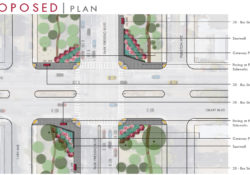
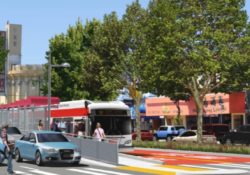
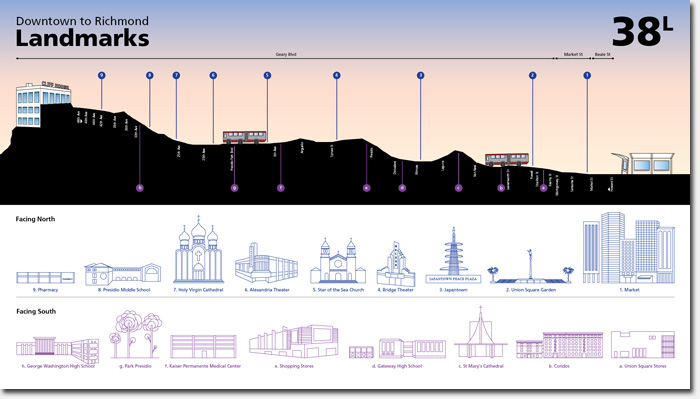
The Geary Bus Rapid Transit project, or Geary BRT for short, is the subject of debate among Richmond District residents. The project is designed to speed up buses and make service more reliable and comfortable along Geary Boulevard, as well as improve pedestrian conditions among the busy corridor with new medians, safer crossings, landscaping and countdown signals.
But the Geary BRT is dismissed by opponents as being too expensive, too disruptive to residents and businesses, and unrealistic in its goals. On the other hand, proponents believe that Geary Boulevard can become the “Great Street” it was always meant to be, and that bus riders will benefit from the service improvements and merchants from the increased ridership into the Richmond District.
To help clarify the two sides of the Geary BRT debate, I invited two Davids to weigh in on the primary issues around the project. They were provided with the same set of questions and asked to keep their answers to no more than 150 words.
Falling into the anti-BRT camp is David Heller, President of the Greater Geary Boulevard Merchants & Property Owners Association and founder of savegearyblvd.com.
For the pro side, I invited Dave Snyder, a regular sf.streetsblogs.org contributor and longtime activist for better transportation. You’ll see the Davids’ side-by-side answers below to some of the top questions that arise when Geary BRT is discussed. But don’t just take their word for it – head over to gearybrt.org to learn more about the project.
Many thanks to David Heller and Dave Snyder for participating in the Q&A.
Sarah B.
——————————————————————
|
Please give a short bio about yourself and explain your relationship to the Geary BRT project: |
|
Dave Snyder: I’m a longtime student of local transportation policy, and activist for better transportation since 1991. After stints as the chief executive of local organizations, the SFBC and Livable City, I served as the transportation policy director for the San Francisco Planning & Urban Research Association where I learned about best practices in public transit and worked to promote improved transit in San Francisco. I learned that BRT systems are an important innovation in public transit that provide a fantastic return on the investment for limited dollars available to build new public transportation infrastructure. |
|
David Heller: As president of the Greater Geary Boulevard and Property Owners Association, I am responsible for actions that benefit or hurt local businesses, which are the life-blood of our community. I served on the first citizens advisory committee, which was comprised to investigate the potential for the Bus Rapid Transit system. |
|
|
As a Richmond District resident, what are the two most important things I should know about the Geary BRT project? |
|
Snyder: (1) That Geary BRT will be public transit unlike anything most of us have ever seen: new vehicles that feel like and operate like trains, stations instead of stops, and faster and more reliable than our current buses and LRVs, and (2) that impacts on car traffic will be minor, almost negligible. |
|
Heller: The BRT project was born in secrecy when the SFMTA snuck enabling legislation into a 10-page bill requesting an extension of sales tax revenues for transportation projects. There was one sentence, on page 6 of the legislation, which called for the BRT plan and made it a “voter mandate†to implement. At the meetings before the November vote on the legislation, the MTA’s advisory board made a decision to not tell anyone in the Richmond District about the legislation’s provisions and to avoid the Richmond District’s numerous community meetings for fear of exposure. As well, the highly-politicized MTA is skewing or misleading the public in its partisan effort to get the program going. For example, the number of cars leaving Geary for other Richmond District roads is expressed in terms of vehicles per minute, not vehicles per hour, which gives a better impression of what the actual impacts would be. |
|
|
What effect will the Geary BRT project have on the businesses along the Geary corridor? |
|
Snyder: All businesses will benefit a little, some a great deal. Geary BRT will attract more people to the corridor as people figure out that if you want to go downtown without your car, you can always walk to Geary and catch a fast and comfortable BRT vehicle in five minutes. This means more people on the Geary sidewalks able to pick up something at a store on their way home. For businesses that need to attract people from the whole city, faster access from Market Street and the Van Ness BRT will make the Richmond an easier destination to access. Construction is usually a hassle, but in this case the sidewalks are hardly being touched, so access to businesses will be unhindered. When the street is dug up, the impact will be much like repaving, which is going to happen anyway, and in fact be coordinated with the BRT construction. |
|
Heller: Businesses will suffer during construction and after. The loss of traffic lanes, left-hand turns and parking spaces will hurt an already battered business district. Traffic will be driven to ancillary streets as people avoid the driving-unfriendly environment of Geary. When the BRT line is converted from buses to light rail vehicles, businesses located between the “transit stations†will suffer. Only the high-traffic “transit station†locations would benefit, and those locations are usually taken by high-volume chain stores, such as Walgreens. |
|
|
In lieu of the BRT project, what else could we be doing to achieve the same objectives of the BRT, which are described on the project website as “to improve travel times, reliability, and the user experience on one of San Francisco’s highest ridership bus routes”? |
|
Snyder: The MTA is already planning to increase the frequency of the 38L and run it until 9:00 p.m. They are also going to adjust the light timing in the eastern portion of Geary. These changes are important practically because they provide better service at less cost to Muni, but they are also important politically because they will provide a sense of optimism among Muni riders. In my experience as a transportation activist, I have learned that people need hope, a sense that the government cares and is making changes to improve the lives of everyday people. Muni riders haven’t had this optimism in a long time, but they deserve it! Boy do they deserve it! If the MTA follows through on these modest improvements, it should make people more enthusiastic about the chances for really fantastic transit that BRT can bring. |
|
Heller: A whole bunch of the recommendations we made to improve transit on Geary is being incorporated into the BRT, including transit signal control and GPS monitoring technology. We recommended transforming one lane of traffic on Geary to a “transit-only†diamond lane during morning and evening commute hours but the plan was dismissed by the MTA, which is hell-bent on spending a quarter of a billion dollars on the project, whether it is needed or not. |
|
|
If/When completed, do you think that the use of public transportation to and from the Richmond District will increase? Why or why not? |
|
Snyder: I’ve come to learn you can’t force people to do something they don’t want to do. You can’t force them out of their cars, or onto bicycles or buses. Most people make a pretty simple calculation about time and money, and choose whatever option is easiest, and worth the money. For example, the 55,000 daily riders of Geary today don’t take the bus to stop global warming, they do it because it’s easy enough and cheap compared to parking or taxis. It’s pretty easy to understand that if you make transit faster, more frequent, more reliable, and more comfortable, more people will take it. |
|
Heller: The Geary BRT is slated to end at 33rd Avenue, not at the Great Highway as it currently is. For riders in the Outer Richmond, there will be a hardship just getting to the new Geary BRT line. Travel times will increase slightly for bus riders, but at what cost to the community – years of extensive construction, a dispersement of vehicles onto other Richmond roads, a loss of businesses, etc. It is a large price to pay for a few years of union construction and the shaving of a few minutes off the average downtown commute. |
|

|
Of the proposed layouts for the BRT lanes, which do you recommend and why? |
|
Snyder: Either of the two center options is better than the side option. The side option eliminates the qualities of BRT that make it seem like a train. The side option will require the bus to be delayed by or swerve around double-parked cars or even cars legally waiting to pull into a spot. This won’t happen with the center option. The side option also does not allow for express buses to pass the locals without swerving. Also, the center option also allows the restoration of parking spaces that are currently occupied by bus stops. In sum, the side option isn’t really BRT. |
|
Heller: Using the outside lanes, with exclusive transit use during busy commute times, is the cheapest, most efficient and cost-effective option. But, because the BRT line has to be “rail ready,†the center lane option is being aggressively pursued by the MTA. Of the two center lane options, one would require a whole new fleet of buses with loading doors on the left side of the bus. That option would also shut down when a bus broke down, making it a “straw†choice. There is only one option that the MTA wants, and all of the other choices being studied are for show only. |
|
|
Finally, please use this space to add any final thoughts about the project. |
|
Snyder: As a transportation professional, I’m excited to see the Geary and Van Ness BRT projects built because I think they will be models for more projects throughout the city. Some say that BART should have been extended under Geary as originally contemplated and they’re right, but this is almost as good and so very much cheaper. This technology doesn’t exist anywhere in the Bay Area, so people can’t appreciate how different it’s going to be than the regular bus. Even though it won’t be trains, it will be better than Muni’s existing surface light rail lines: just as comfortable but more frequent and faster. Where BRT does exist around the world, it’s very popular and beloved. Once we have it, San Franciscans will wonder why we didn’t do it sooner. It’s about time we joined the rest of the world and implemented this new idea to improve transit. |
|
Heller: The MTA’s Geary BRT plan should be scrapped. It does little for improving commute times or the quality of ride on the Geary #38 bus line and costs upwards of $250 million. The MTA claims the new bus line would increase ridership, but when pressed to explain who the additional riders would be, the MTA has no answers, other than saying people would leave their cars behind to ride the Geary #38 bus line. The population of the Richmond District is not expected to increase much in the next decade, so increased ridership is a red herring. Perhaps the MTA will fill the buses up with commuters from other Bay Area cities, further impacting the parking problems in the Richmond. |
|
11:09 pm | Posted under
Business,
Muni,
Traffic |
86 comments