Random header image... Refresh for more!

Archive for the ‘Traffic’ Category

Nov-11-2009

The pros and cons of the Geary Bus Rapid Transit Project


The Geary Bus Rapid Transit project, or Geary BRT for short, is the subject of debate among Richmond District residents. The project is designed to speed up buses and make service more reliable and comfortable along Geary Boulevard, as well as improve pedestrian conditions among the busy corridor with new medians, safer crossings, landscaping and countdown signals.

But the Geary BRT is dismissed by opponents as being too expensive, too disruptive to residents and businesses, and unrealistic in its goals. On the other hand, proponents believe that Geary Boulevard can become the “Great Street” it was always meant to be, and that bus riders will benefit from the service improvements and merchants from the increased ridership into the Richmond District.

To help clarify the two sides of the Geary BRT debate, I invited two Davids to weigh in on the primary issues around the project. They were provided with the same set of questions and asked to keep their answers to no more than 150 words.

Falling into the anti-BRT camp is David Heller, President of the Greater Geary Boulevard Merchants & Property Owners Association and founder of savegearyblvd.com.

For the pro side, I invited Dave Snyder, a regular sf.streetsblogs.org contributor and longtime activist for better transportation. You’ll see the Davids’ side-by-side answers below to some of the top questions that arise when Geary BRT is discussed. But don’t just take their word for it – head over to gearybrt.org to learn more about the project.

Many thanks to David Heller and Dave Snyder for participating in the Q&A.

Sarah B.

——————————————————————

Please give a short bio about yourself and explain your relationship to the Geary BRT project:
Dave Snyder: I’m a longtime student of local transportation policy, and activist for better transportation since 1991. After stints as the chief executive of local organizations, the SFBC and Livable City, I served as the transportation policy director for the San Francisco Planning & Urban Research Association where I learned about best practices in public transit and worked to promote improved transit in San Francisco. I learned that BRT systems are an important innovation in public transit that provide a fantastic return on the investment for limited dollars available to build new public transportation infrastructure. David Heller: As president of the Greater Geary Boulevard and Property Owners Association, I am responsible for actions that benefit or hurt local businesses, which are the life-blood of our community. I served on the first citizens advisory committee, which was comprised to investigate the potential for the Bus Rapid Transit system.

As a Richmond District resident, what are the two most important things I should know about the Geary BRT project?
Snyder: (1) That Geary BRT will be public transit unlike anything most of us have ever seen: new vehicles that feel like and operate like trains, stations instead of stops, and faster and more reliable than our current buses and LRVs, and (2) that impacts on car traffic will be minor, almost negligible. Heller: The BRT project was born in secrecy when the SFMTA snuck enabling legislation into a 10-page bill requesting an extension of sales tax revenues for transportation projects. There was one sentence, on page 6 of the legislation, which called for the BRT plan and made it a “voter mandate” to implement. At the meetings before the November vote on the legislation, the MTA’s advisory board made a decision to not tell anyone in the Richmond District about the legislation’s provisions and to avoid the Richmond District’s numerous community meetings for fear of exposure. As well, the highly-politicized MTA is skewing or misleading the public in its partisan effort to get the program going. For example, the number of cars leaving Geary for other Richmond District roads is expressed in terms of vehicles per minute, not vehicles per hour, which gives a better impression of what the actual impacts would be.

What effect will the Geary BRT project have on the businesses along the Geary corridor?
Snyder: All businesses will benefit a little, some a great deal. Geary BRT will attract more people to the corridor as people figure out that if you want to go downtown without your car, you can always walk to Geary and catch a fast and comfortable BRT vehicle in five minutes. This means more people on the Geary sidewalks able to pick up something at a store on their way home. For businesses that need to attract people from the whole city, faster access from Market Street and the Van Ness BRT will make the Richmond an easier destination to access. Construction is usually a hassle, but in this case the sidewalks are hardly being touched, so access to businesses will be unhindered. When the street is dug up, the impact will be much like repaving, which is going to happen anyway, and in fact be coordinated with the BRT construction. Heller: Businesses will suffer during construction and after. The loss of traffic lanes, left-hand turns and parking spaces will hurt an already battered business district. Traffic will be driven to ancillary streets as people avoid the driving-unfriendly environment of Geary. When the BRT line is converted from buses to light rail vehicles, businesses located between the “transit stations” will suffer. Only the high-traffic “transit station” locations would benefit, and those locations are usually taken by high-volume chain stores, such as Walgreens.

In lieu of the BRT project, what else could we be doing to achieve the same objectives of the BRT, which are described on the project website as “to improve travel times, reliability, and the user experience on one of San Francisco’s highest ridership bus routes”?
Snyder: The MTA is already planning to increase the frequency of the 38L and run it until 9:00 p.m. They are also going to adjust the light timing in the eastern portion of Geary. These changes are important practically because they provide better service at less cost to Muni, but they are also important politically because they will provide a sense of optimism among Muni riders. In my experience as a transportation activist, I have learned that people need hope, a sense that the government cares and is making changes to improve the lives of everyday people. Muni riders haven’t had this optimism in a long time, but they deserve it! Boy do they deserve it! If the MTA follows through on these modest improvements, it should make people more enthusiastic about the chances for really fantastic transit that BRT can bring. Heller: A whole bunch of the recommendations we made to improve transit on Geary is being incorporated into the BRT, including transit signal control and GPS monitoring technology. We recommended transforming one lane of traffic on Geary to a “transit-only” diamond lane during morning and evening commute hours but the plan was dismissed by the MTA, which is hell-bent on spending a quarter of a billion dollars on the project, whether it is needed or not.

If/When completed, do you think that the use of public transportation to and from the Richmond District will increase? Why or why not?
Snyder: I’ve come to learn you can’t force people to do something they don’t want to do. You can’t force them out of their cars, or onto bicycles or buses. Most people make a pretty simple calculation about time and money, and choose whatever option is easiest, and worth the money. For example, the 55,000 daily riders of Geary today don’t take the bus to stop global warming, they do it because it’s easy enough and cheap compared to parking or taxis. It’s pretty easy to understand that if you make transit faster, more frequent, more reliable, and more comfortable, more people will take it. Heller: The Geary BRT is slated to end at 33rd Avenue, not at the Great Highway as it currently is. For riders in the Outer Richmond, there will be a hardship just getting to the new Geary BRT line. Travel times will increase slightly for bus riders, but at what cost to the community – years of extensive construction, a dispersement of vehicles onto other Richmond roads, a loss of businesses, etc. It is a large price to pay for a few years of union construction and the shaving of a few minutes off the average downtown commute.


Of the proposed layouts for the BRT lanes, which do you recommend and why?
Snyder: Either of the two center options is better than the side option. The side option eliminates the qualities of BRT that make it seem like a train. The side option will require the bus to be delayed by or swerve around double-parked cars or even cars legally waiting to pull into a spot. This won’t happen with the center option. The side option also does not allow for express buses to pass the locals without swerving. Also, the center option also allows the restoration of parking spaces that are currently occupied by bus stops. In sum, the side option isn’t really BRT. Heller: Using the outside lanes, with exclusive transit use during busy commute times, is the cheapest, most efficient and cost-effective option. But, because the BRT line has to be “rail ready”, the center lane option is being aggressively pursued by the MTA. Of the two center lane options, one would require a whole new fleet of buses with loading doors on the left side of the bus. That option would also shut down when a bus broke down, making it a “straw” choice. There is only one option that the MTA wants, and all of the other choices being studied are for show only.

Finally, please use this space to add any final thoughts about the project.
Snyder: As a transportation professional, I’m excited to see the Geary and Van Ness BRT projects built because I think they will be models for more projects throughout the city. Some say that BART should have been extended under Geary as originally contemplated and they’re right, but this is almost as good and so very much cheaper. This technology doesn’t exist anywhere in the Bay Area, so people can’t appreciate how different it’s going to be than the regular bus. Even though it won’t be trains, it will be better than Muni’s existing surface light rail lines: just as comfortable but more frequent and faster. Where BRT does exist around the world, it’s very popular and beloved. Once we have it, San Franciscans will wonder why we didn’t do it sooner. It’s about time we joined the rest of the world and implemented this new idea to improve transit. Heller: The MTA’s Geary BRT plan should be scrapped. It does little for improving commute times or the quality of ride on the Geary #38 bus line and costs upwards of $250 million. The MTA claims the new bus line would increase ridership, but when pressed to explain who the additional riders would be, the MTA has no answers, other than saying people would leave their cars behind to ride the Geary #38 bus line. The population of the Richmond District is not expected to increase much in the next decade, so increased ridership is a red herring. Perhaps the MTA will fill the buses up with commuters from other Bay Area cities, further impacting the parking problems in the Richmond.

11:09 pm | Posted under Business, Muni, Traffic | 92 comments
Oct-31-2009

Doyle Drive / Presidio Parkway update

On Wednesday night, about thirty residents attended the Doyle Drive / Presidio Parkway public meeting at Self Help for the Elderly on Geary. The meeting was hosted by Molly Graham, Director of Public Outreach for the project, and Nadal Tuqan, the Caltrans Project Manager. David Pang, Caltrans Construction Manager for the project was also in attendance. All three spoke while sharing a powerpoint presentation about Doyle’s planned transformation into the new Presidio Parkway by 2013.

Doyle Drive currently handles 144,000 persons traveling per weekday. The primary reason for replacing it is its failure to meet federal safety standards. At least 80% of the current structure cannot be suitably retrofitted so replacement is the only option.

The new Presidio Parkway will also be safer for drivers, offering wider, 11′ lanes, a median barrier, and road shoulders. The new parkway will also do a better job of slowing traffic down as it enters Marina streets.

Construction will begin next month, though planners have yet to publish the final schedule. By 2011, an alternate road/detour will be in place and they will demolish the existing Doyle Drive roadway, mostly over a planned 3-day weekend closure. Once major construction is completed, the new Presidio Parkway will open in 2013 with final work such as landscaping finishing up in 2014.

The team’s powerpoint presentation was filled with slick animations showing the envisioned Presidio Parkway. The new design calls for two tunnels along the 1.5 mile span which will be excavated underground, eliminating much of today’s unsightly, raised roadway which was originally designed to meet security requirements for the Army base. The new roadway does a much better job of blending in with the Presidio’s surroundings.

The parkway design will also offer new exits with direct access to the Presidio. With the increase in businesses and attractions taking root in the Presidio, these new outlets should help ease congestion that would normally be routed onto Lombard or Marina Boulevard.

David Pang, the Caltrans Construction Manager for the project, is eminently qualified for the nearly four year long effort. With 25 years at Caltrans and the former manager of the Cypress Freeway cleanup (after the ’89 quake) and the Devil’s Slide upgrade, Pang also brings a local perspective to the project as a SF native and current resident of the Richmond District.

Several neighbors in attendance were concerned about the increase in construction traffic at the various Presidio entrances at 25th Avenue, Arguello Boulvard and 15th Avenue. Pang assured residents that construction companies are prohibited in their contracts from using these entry or exit points, and that a hotline has been set up to allow neighbors to report any issues they experience during the construction project.

Molly Graham, Director of Public Outreach, said she personally monitors the hotline and has a direct line into Pang on-site. She advised neighbors to “try and catch the truck logos” to help them identify which crews may be in violation. The hotline is (415) 263-5953 or you can email info@presidioparkway.org. “You are our eyes and ears”, Graham said.


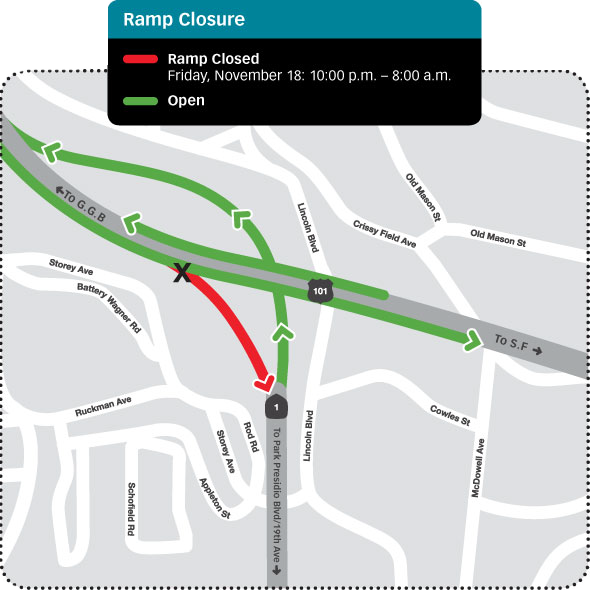
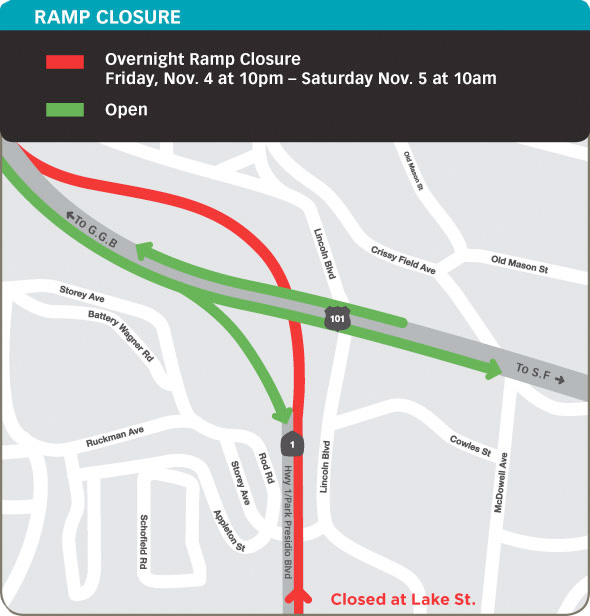
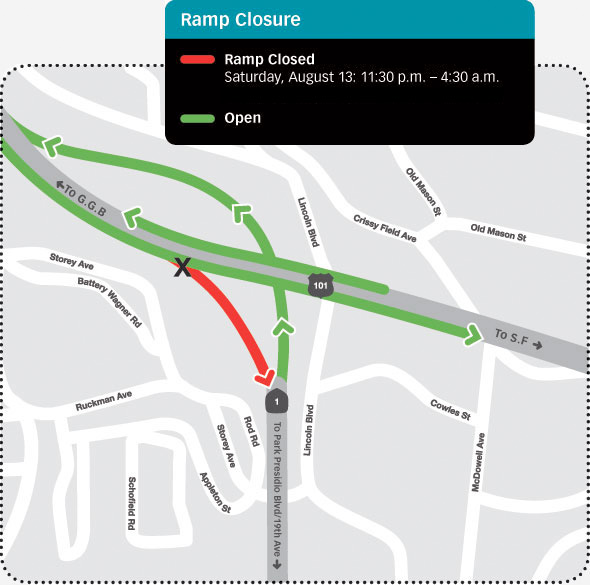
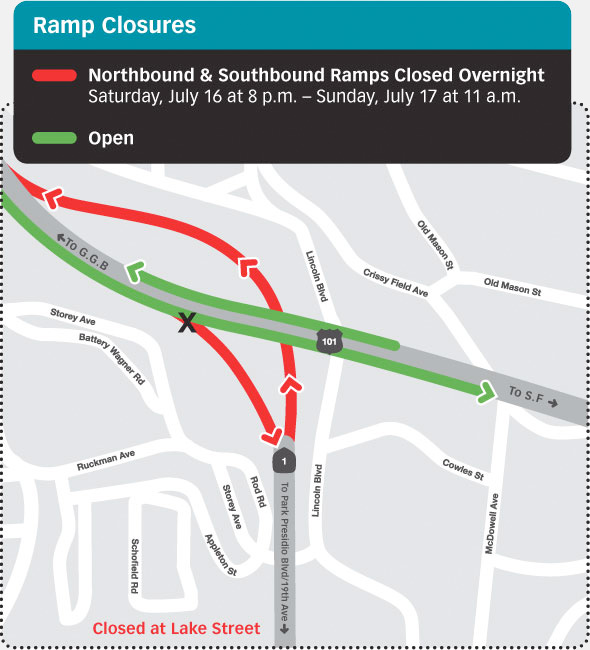
Few neighbors seemed concerned about the planned closures of the ramps that connect Park Presidio to Doyle Drive, allowing the quickest route between the Richmond and the Marina. Project studies showed that between 5000-10,000 vehicles use the ramps each day. The northbound ramp will be closed for most of the project, while the southbound ramp’s closure is planned for 2010 – 2011.

Graham admitted that the suggested signed detours look preposterous to residents as they take drivers way out of their way, but she noted they are designed to steer traffic to the routes that can best handle increased volume. She likened them to the routes that a visiting Winnebago would take, rather than the neighborhood streets that most residents would turn to for their alternate route.

Once construction kicks off, there will be a public information office on-site in the Presidio, offering information, answering questions, and even giving tours of the construction as certain phases are completed.

For more information, visit the Presidio Parkway website at presidioparkway.org. To receive updates about the project such as planned traffic closure, join their email list or follow them on Twitter.

Sarah B.

1:38 pm | Posted under Traffic | Comments Off
Oct-22-2009

Meetings about Doyle Drive ramp closures – Oct. 29, Nov. 4

Starting next week, the Presidio Parkway Project will hold two community meetings in the Richmond District and the Marina to help residents learn more about the upcoming construction and in particular, the planned ramp closures.

The current plan calls for the following ramp closures which will block access between the Richmond District and the Marina:

  • November 2009 – 2013 closure of the off-ramp from northbound Doyle Drive to southbound Park Presidio / Highway 1
  • Early 2010 – 2011 closure of the off-ramp from northbound Park Presidio/Highway 1 to southbound Doyle Drive.

    Construction of the new Presidio Parkway, which replaces the current Doyle Drive, begins next month. The project start date was accelerated by more than a year due to a $50 million influx of project funds from the American Recovery and Reinvestment Act of 2009.

    Judging by the meeting agenda, I don’t get the feeling that organizers are looking for feedback from residents. From 6-6:15 is an open house, then a presentation, followed by “Resume open house”. Where’s the Q&A?

    How do you feel about these lengthy ramp closures? I use these routes frequently and am not looking forward to the inconvenience.

    Richmond District | Thursday, October 29, 2009, 6:00-7:30 p.m.
    Self-Help for the Elderly, 408 22nd Avenue (at Geary Boulevard)

    Marina | Wednesday, November 4, 2009, 6:00-7:30 p.m.
    Fort Mason Center (Marina Blvd. and Buchanan St.)
    Landmark Building A Conference Center | Golden Gate Room

    Sarah B.


    An animation showing Doyle Drive today and the planned Presidio Parkway in its place.

    8:22 pm | Posted under Community, Traffic | 5 comments
  • Oct-14-2009

    Road closures for Nike Marathon on Sunday

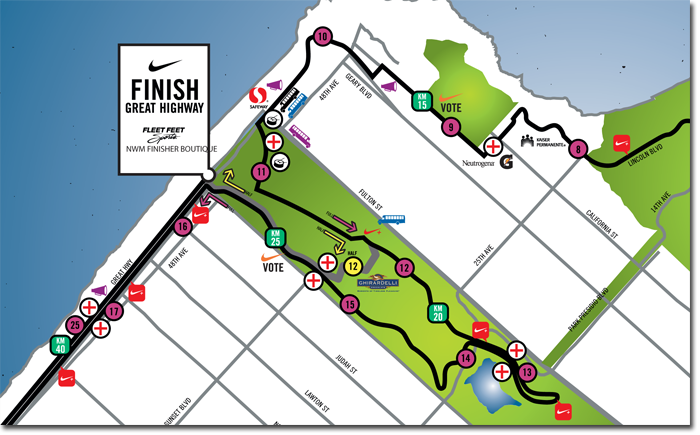
    This Sunday, the Nike Women’s Marathon will weave its way through parts of the outer Richmond and Golden Gate Park (course map. Here are some closures you should be aware of so you don’t get snagged in bad traffic. Thanks to PAR for this information.

    If you’d like to watch the runners huff and puff, see the course map to pick a good spot. Looks like Clement & 36th (mile 9), El Camino del Mar and 26th Avenue (mile 8), Point Lobos & Great Highway (mile 10), and many spots in Golden Gate Park will be good viewing points. The race begins at 7am.

    Sarah B.

    Closures

    OCEAN BEACH PARKING LOT from Stairwell #18 through Stairwell # 27* will be closed from 12 Midnight on Tuesday, October 13, 2009 through Tuesday, October 20, 2009 at 12 noon. (See attached diagram for set up)

    OCEAN BEACH PARKING LOT from Stairwell #15 through Stairwell # 18* will be closed from 12 Midnight on Sunday, October 18, 2009 until 6:00 p.m. (See attached diagram for set up)

    *Stairwell 18 is at Great Highway & Fulton; numbers increase as you head south down the Great Highway.

    BEACH CHALET SOCCER FIELD PARKING LOT from 3:00 a.m. – 4:00 p.m. on Sunday, October 18, 2009 for VIP and volunteer parking.

    ALL ROADS ON THE WEST END OF GOLDEN GATE PARK from Transverse to the Great Highway will be closed from 3:00 a.m. until 2:30 p.m. on Sunday, October 18, 2009.

    GREAT HIGHWAY: will be closed from Skyline Blvd/Great highway to Fulton Street from 12:00 a.m. until 4:00 p.m. on Sunday, October 18, 2009.

    Westbound parking lane on JFK from 47th Street to the Great Highway for Bus Staging area from 3:00a.m.-4:00p.m. on October 18, 2009.

    Northbound parking lane on the Great Highway from Fulton Street to Cabrillo Street for Bus Staging are from 1:00a.m.-4:00p.m. on October 18, 2009.

    Roads through Sea Cliff and Clement/Seal Rock Drive will also be affected.

    12:15 pm | Posted under Events, Sports, Traffic | 7 comments
    Sep-24-2009

    Final Doyle Drive ramp closures this weekend

    Like last weekend, the off-ramps from Highway 101/Doyle Drive to southbound Highway 1/Park Presidio Boulevard will be closed this Saturday and Sunday from 5:30am-11:30am. Detour information.

    Hallelujah! The prep work on Doyle is almost finished. For more information on the Doyle Drive/Presidio Parkway project, visit doyledrive.org.

    Sarah B.

    6:05 am | Posted under Traffic | Comments Off
    Sep-17-2009

    Doyle Drive ramp closures this weekend

    Like last weekend, the off-ramps from Highway 101/Doyle Drive to southbound Highway 1/Park Presidio Boulevard will be closed this Saturday and Sunday from 5:30am-11:30am. Detour information.

    After this, we’ll have just one more weekend of Doyle Drive closures on September 26-27 to complete the prep work. For more information on the Doyle Drive/Presidio Parkway project, visit doyledrive.org.

    Sarah B.

    3:40 pm | Posted under Traffic | Comments Off
    Sep-10-2009

    Doyle Drive closures resume this weekend

    This Saturday and Sunday, September 12 and 13, Doyle Drive will be closed from 5:30am to 11:30am to continue prep work for the Doyle Drive Replacement Project.

    Doyle Drive is the portion of Highway 101 that connects the Golden Gate Bridge with the Marina District and Crissy Field; it basically runs parallel to Crissy. During the closures, Doyle Drive will be completely closed to traffic. Note that the Park Presidio/19th Avenue route from the Richmond onto the Golden Gate Bridge will still be open.

    Heading south from the toll plaza, the off-ramp to southbound state Highway 1 will be closed, and heading north from the Marina District to the toll plaza, the off-ramp to southbound state Highway 1 will also be closed.

    Drivers heading south of the toll plaza and looking to get to Highway 1 will be directed by detour signs to continue on Doyle Drive, take Lombard Street to Van Ness Avenue, and then take Geary Boulevard to Highway 1/19th Avenue. Wow, talk about going the long way.

    Drivers heading north toward the toll plaza and seeking to exit onto Highway 1 will be directed past the closed off-ramp to the last exit before the toll plaza, and to take Lincoln Boulevard to 25th Avenue, and then Geary Boulevard to Highway 1/19th Avenue.

    This is the first of three more weekends of closures. Doyle Drive will also be closed from 5:30am to 11:30am on Sept. 19 and Sept. 20, as well as on Sept. 26 and Sept. 27.

    Curious what the new Park Presidio Parkway will look like when it’s completed in 2013? Check out the aerial simulation video below. Or check out pics of the work done during the last closure.

    Sarah B.


    2:02 pm | Posted under Traffic | Comments Off
    Aug-19-2009

    Doyle Drive closures begin this weekend

    This Saturday and Sunday from 5:30am to 11:30am marks the first of several closures of Doyle Drive that will take place over the next several weekends. The closures are required to conduct tree removal in preparation for the initial construction of the Doyle Drive Replacement Project.

    Doyle Drive is the portion of Highway 101 that connects the Golden Gate Bridge with the Marina District and Crissy Field; it basically runs parallel to Crissy. During the closures, Doyle Drive will be completely closed to traffic. The closures will take place Saturdays and Sundays, from 5:30 a.m. to 11:30 a.m., on the following dates:

    Aug. 22 and Aug. 23
    Sept. 12 and Sept. 13
    Sept. 19 and Sept. 20
    Sept. 26 and Sept. 27

    Note that the Park Presidio/19th Avenue route from the Richmond onto the Golden Gate Bridge will still be open. As you head towards the bridge, the right hand exit ramp to Doyle Drive will be closed. And as you enter the city from the bridge, the lanes off to the left onto Doyle Drive will be blocked off.

    If you are planning a trip to that part of the city from the Richmond, plan on taking Geary, California or another major thoroughfare.

    According to the SFMTA project site for the Doyle Drive Replacment Project, the span is being rebuilt to address a number of concerns about the aging, 1.5 mile span:

    Constructed almost 60 years ago to provide direct access to the Golden Gate Bridge, Doyle Drive has deteriorated structurally and cannot accommodate the existing traffic volume. The problems include: Lanes that are too narrow by 2 to 3 feet, lack of a barrier separating opposing traffic flows, lack of shoulders for use by disabled vehicles, maintenance crews, and emergency and enforcement vehicles. As of 1992, Doyle Drive was experiencing almost three times the normal number of accidents for a facility of its type. In addition, the effects of heavy traffic and exposure to salt air have significantly deteriorated the structures that support the elevated roadway. Maintenance and seismic retrofit measures may add a few years to its service life. However, with the current situation, Doyle Drive may be vulnerable to earthquake damage.

    Construction for the project is slated to begin this Fall, with completion planned for 2013 at an estimated cost of $1.05 billion. Once completed, the span will be renamed “Presidio Parkway”.


    A simulation of the new Park Presidio Parkway, due for completion in 2013

    In a recent public meeting about the project, there was intense concern about the planned closures of Doyle Drive during the major phases of construction.

    At that meeting, the project director for the California Department of Transportation outlined a plan to close the ramp from northbound Park Presidio to southbound Doyle Drive before the end of this year, and keep it closed for up to 18 months. This would mean that the usual 5 minute drive from the Richmond to the Marina District and Crissy Field would no longer be available.

    In addition, the ramp from northbound Doyle Drive to southbound Park Presidio will be closed around the same time, and remain closed for the duration of the project. This is the small offramp/turn that you see just before getting to the bridge. Again, an incredibly fast, convenient way to get from the Marina area to the Richmond that would be closed off for up to three years.

    Golden Gate Bridge authorities expect a significant loss of revenue from the lengthy closures as frustrated drivers from both ends will likely avoid the extra hassle of trying to reach the bridge during the three year project. Read more about the controversy at kcbs.com

    For more information on the Doyle Drive Reconstruction Project, visit http://doyledrive.org.

    Sarah B.

    An aerial simulation showing the new Presidio Parkway:


    7:35 am | Posted under Traffic | 5 comments